

What if a clock could make the time easier to read without making a room feel less like home? A 3D LED wall clock gives a room a crisp digital accent, but choosing one that sits comfortably amongst softer, cottage-inspired details takes more than a quick glance at a product listing.
When comparing clocks, separate what is stated about the display from decorative wording. A bright digital look may suit one space, while another calls for a quieter visual balance. The right choice should feel comfortable to look at and practical in your daily routine.
This guide covers the details to compare, how to assess a viewing position and whether a digital style suits your home. Lilyrose’s 3D LED Wall Clock, Digital Display is part of a home décor collection shaped by a warm, rustic sensibility. We’ll look at how a modern display can find its place in a thoughtfully arranged home. Free delivery is available from Lilyrose.
Key Takeaways
- Understand what “3D” describes in a digital clock, and why it doesn’t guarantee a particular feature or specification.
- Distinguish practical display details from decorative wording when comparing a 3D LED wall clock.
- Compare digital, analogue and minimalist clocks by readability and visual presence.
- Use a room-by-room approach to choose a viewing position and decide whether the clock should stand out or blend in.
- Explore Lilyrose’s 3D LED Wall Clock, Digital Display as a digital timekeeping accent for a considered home.
What Is a 3D LED Wall Clock, and What Makes It Distinctive?
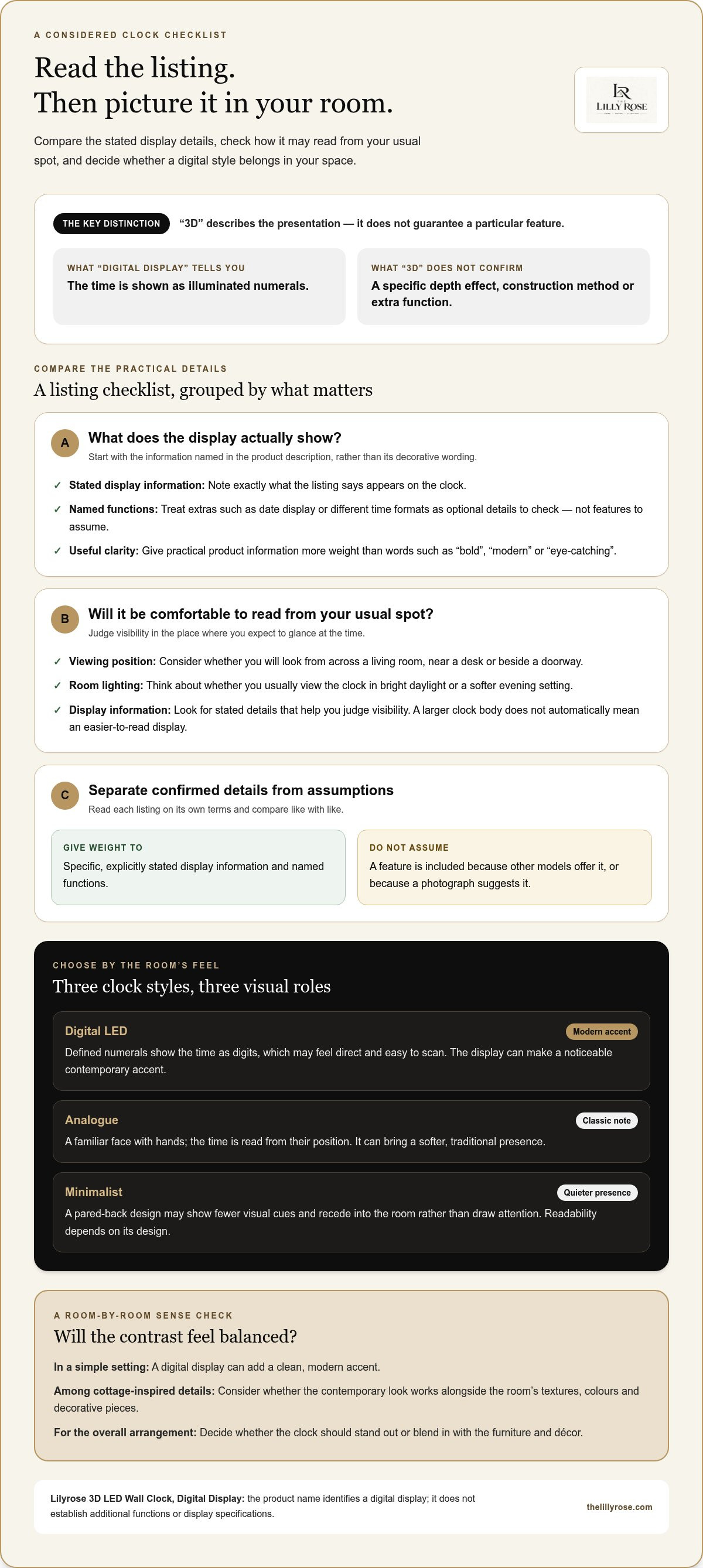
A 3D LED wall clock shows the time as illuminated digits on a digital display. This gives it a different look from an analogue clock, which uses hands and a numbered face. “3D” describes the presentation, but doesn’t guarantee a particular depth effect, construction method or feature.
That distinction is useful when reading product descriptions. “Digital display” tells you how the time is shown, while “3D” may be descriptive rather than technical. A product title alone might not explain how the display looks or what functions the clock has. Compare the stated details instead of assuming that every clock with “3D” in its name is built or presented in the same way.
What does “3D” mean in a 3D LED wall clock?
Across this product category, “3D” is a visual description, not a standard guarantee of a particular design or depth. It may suggest a distinctive digital appearance, but it doesn’t establish how that effect is created. For background on the display itself, LED display technology explains how LED displays work. Read each product description on its own terms.
Why choose a digital wall clock for a living space?
A digital display presents the time as numerals, which some people find easy to read at a glance. An analogue clock has a familiar face, with hands that can give it a classic, softer presence. Neither style suits every room. Consider which feels natural in the space and whether you want the clock to blend in or add a contemporary note.
A clock also contributes to a room’s visual arrangement, alongside furniture, artwork and decorative pieces. A digital display can add a clean, modern accent to a simple setting, or contrast with the textures and warmth of cottage-inspired décor. The surrounding colours, materials and objects help determine whether that contrast feels balanced.
Lilyrose’s 3D LED Wall Clock, Digital Display brings digital timekeeping into a collection with a warm, rustic sensibility. Its modern look can sit amongst traditional details as a deliberate contrast. Start by deciding whether that combination suits your space, then compare the product details that matter to your everyday use.
Which Display Details Matter Most in a 3D LED Wall Clock?
To compare product listings clearly, separate what the clock is stated to display from decorative descriptions and optional functions. Start with the basics: what information appears on the display, and will you be able to read it comfortably from your usual viewing position?
Words such as “bold”, “modern” or “eye-catching” can help describe a clock’s style, but they don’t explain how it will work in your room. Give more weight to specific stated details, and don’t assume a feature is included just because it appears on other models. The name of Lilyrose’s product, 3D LED Wall Clock, Digital Display, identifies its digital display. It doesn’t establish additional functions or display specifications.
How can you judge whether a digital display will be easy to read?
Picture your usual viewing position before buying. A clock viewed from across a living room needs to be assessed differently from one near a desk or beside a doorway. Consider the room’s lighting, too: will you usually view it in bright daylight, or in a softer evening setting?
Display size and visibility are related, but they aren’t the same. A larger clock body doesn’t automatically mean the time will be easier to read from your chosen spot. Look for stated information about the display itself and assess whether the listing gives enough detail to judge its likely visibility in your room. Don’t infer a particular size or brightness setting from photographs or general descriptions.
Which product details should you compare before buying?
Read each listing individually and compare like with like. The time display is the central function. Other details, such as showing the date or offering different time formats, are optional functions that matter only if you’ll use them. These are examples of details to look for, not features to assume are present.
- Stated display information: Note exactly what the listing says the clock shows.
- Named functions: Separate explicitly described extras from the core time display.
- Useful clarity: Look for practical information, not only appearance-led wording.
This checklist makes product details easier to compare. For a fuller feature checklist, look for guidance titled Digital Display Wall Clock: Features to Consider, then compare its points with the details stated for each clock you’re considering.
Once you’ve decided which details matter in your space, view Lilyrose’s digital wall clock as an option for bringing a digital display into a thoughtfully arranged home.
How to Compare a 3D LED Wall Clock with Other Clock Styles
A clock’s appeal depends on more than how it tells the time. Its face, visual weight and position all shape how it feels in a room. Compare styles by weighing the directness of a digital readout against the familiar character of an analogue face or the quieter presence of a minimalist design.
| Clock style | Visual character | At-a-glance time reading | Décor presence |
|---|---|---|---|
| Digital LED | Contemporary, defined numerals | Time appears as digits, which may feel direct and easy to scan | Can make a noticeable modern accent |
| Analogue | Familiar face with hands | Read by interpreting the position of the hands | Can bring a classic, traditional note |
| Minimalist | Simple, pared-back appearance | Depends on its design; a pared-back face may show fewer visual cues | May recede into the room rather than draw attention |
These are broad impressions, not fixed rules. An analogue clock can be bold and decorative, while a digital model can be restrained. “Minimalist” describes an aesthetic rather than one timekeeping method, so the display and reading experience vary from clock to clock.
When might a digital LED clock suit your preferences?
A digital LED clock may appeal if you enjoy contemporary details and prefer seeing the time as numerals. Consider whether that direct display suits the room, perhaps a shared space where you glance at the time as you pass through. Its defined appearance can also create a deliberate contrast with softer colours, natural textures or cottage-inspired pieces.
When might an analogue or understated clock feel more at home?
An analogue face offers a familiar visual language, with hands that can lend a wall a gentle, traditional quality. If you’d rather the clock blend quietly into its surroundings, an understated design may feel more comfortable than a prominent display. These are personal preferences, not decorating rules: a digital clock can suit a warm interior, just as an analogue face can become a focal point.
Choose according to the room’s mood, whether you prefer reading numerals or hands, how noticeable you want the clock to be, and how it relates to the existing décor. Imagine each style in its intended position. Would you welcome its presence every day, or prefer it to fade into the background?
Lilyrose’s 3D LED Wall Clock, Digital Display is a digital option for a thoughtfully arranged home. Compare its stated details with your preferences to decide whether its contemporary display feels like a natural addition.
How to Choose the Right Place and Role for a 3D LED Wall Clock
A clock feels more at home when its position reflects how you use the space and the atmosphere you want to create. Instead of choosing a wall just because it looks empty, consider your daily routines, viewing position and the objects nearby. This helps you decide whether the clock should catch the eye or sit quietly within the room.
Which room should you consider first?
Begin with the room where seeing the time would be useful in your routine. You might often pass through a shared living space, or want a clear time display in a room where you relax. Then consider whether the room’s décor feels comfortable alongside a contemporary accent. A digital clock can contrast with softer, rustic details without requiring you to change the rest of the room.
Use this simple process to choose a position and visual role:
- Choose a room. Start where a visible time display fits naturally into how you use the space.
- Identify a viewing position. Picture where you’re most likely to glance at the clock and whether it will be easy to notice from there.
- Consider visual balance. Decide whether the clock should be a focal point or a practical accent alongside the room’s other features.
How can the clock sit comfortably within the room?
Once you have a possible position in mind, look at the nearby colours and materials. A digital display may stand out against a soft, textured setting or sit comfortably amongst simpler, more contemporary details. Neither effect is automatically better. Aim for a contrast that feels deliberate and pleasant in the room.
Give the clock some visual breathing space. If it will sit near artwork, shelves or other decorative pieces, check whether the area feels crowded and whether each object still has room to be noticed. Temporarily moving a nearby ornament or picture can help you assess the wall without committing to a full rearrangement.
Preview the intended position from where you’ll usually view the clock. Step back, sit down or walk through the room as you normally would. A position that looks balanced up close may feel different from across the room. For styling inspiration, How to Style a Decorative LED Wall Clock offers ideas for considering the relationship between a display and the details around it.
Ready to consider a digital accent for your home? Explore Lilyrose’s 3D LED Wall Clock, Digital Display.
Discover Lilyrose’s 3D LED Wall Clock, Digital Display
Lilyrose’s 3D LED Wall Clock, Digital Display brings digital timekeeping into a considered home. The product name identifies its digital display, while “3D” is part of its description. When deciding whether it suits your room and daily habits, focus on the details provided for this clock rather than assuming it has functions found on other digital models.
The clock is part of Lilyrose’s handpicked home décor, curated with a warm, rustic cottage sensibility. It can introduce a contemporary note without sacrificing the softness of a cottage-inspired interior. Positioning and visual balance help the contrast feel intentional.
A digital accent within a cottage-inspired home
Think of the clock as one element in a wider arrangement, rather than a piece that needs to dictate the room’s style. Against a softer, layered interior, its digital character can offer contrast. In simpler surroundings, it can become a more noticeable accent. Neither approach is a formula; aim for a balance that feels calm and personal.
Consider the colours and materials nearby, as well as the artwork or furnishings that already draw the eye. Give the clock room to register without making the wall feel crowded. If the space has several focal points, choose a position where the clock can be seen without competing for attention. A little breathing space can help a contemporary detail sit comfortably amongst familiar, homely touches.
Picture the clock in its intended position during an ordinary moment at home, rather than judging it only as an isolated product. Does its presence suit the room’s mood? Would it work as a focal point or a quieter practical accent? The best choice is the one that feels at home in your surroundings.
Take a relaxed next step with Lilyrose
You’ve considered the display style you prefer, the role a clock might play in a room and the value of relying on stated product details. Use those priorities to decide whether Lilyrose’s clock belongs on your shortlist, without getting caught up in decorative wording or assumed extras.
Free delivery is available from Lilyrose. Explore Lilyrose’s home décor and browse the curated selection, including the 3D LED Wall Clock, Digital Display.
Make Space for a Thoughtful Everyday Accent
A clock becomes part of the small rhythms of home: a glance before heading out or a pause between tasks. Let that everyday use guide your choice. If a 3D LED wall clock suits the way you like to read the time and feels at ease in its intended position, it can bring a contemporary note to a room without changing its welcoming character.
Lilyrose’s 3D LED Wall Clock, Digital Display is part of its handpicked décor, curated with a rustic, cottage-inspired sensibility. Free delivery is available, and the clock sits alongside the shop’s wider selection. Picture how it might fit amongst the details you already love, then browse at your own pace.
Explore Lilyrose’s home décor and find an accent that feels right for your home.
Frequently Asked Questions
How much electricity does a 3D LED wall clock use?
Electricity use depends on the particular clock and its stated power rating. If the product information gives a wattage, estimate energy use by multiplying the watts by the number of hours it’s used, then dividing by 1,000. The result is an estimate in kilowatt-hours. Use the number of hours you expect it to be on rather than assuming all clocks consume the same amount.
Can a 3D LED wall clock be used in a bedroom?
It can, if its display and overall presence feel comfortable in your bedroom. Consider the atmosphere you want, whether restful and understated or more contemporary, and where the clock would sit in relation to your bed and usual line of sight. Product functions vary, so don’t assume a display can be dimmed or adjusted unless the product description says so.
How do you clean a 3D LED wall clock?
Follow the care instructions supplied with the specific clock, as cleaning guidance can vary by product. Where the instructions allow, a soft, dry cloth may be suitable for gently wiping the surface. Avoid liquids around electrical components, and don’t force open or remove parts of the display or casing. If the care information doesn’t address a particular concern, avoid experimenting with products or methods that could damage the clock.
Can you use a 3D LED wall clock during a power cut?
That depends on the clock’s power design and the specifications given for that product. Don’t assume its display will remain visible during an outage, or that the time and other settings will be retained afterwards. If this matters to you, look for explicit information about power and what happens when it’s interrupted. These details vary by model and shouldn’t be inferred from the 3D LED clock category.
Is a 3D LED wall clock a suitable gift?
It may be a thoughtful gift for someone who enjoys digital displays and distinctive home accents. Consider the recipient’s décor and whether a contemporary clock would feel at home in their space. Their everyday preferences matter, too: they may favour a digital readout or a traditional clock face. Paying attention to personal taste can make a practical object feel considered and warmly chosen.