

Last Updated: November 22, 2026
Quick Summary
Durable kitchen essentials for a first home are the items you use daily, chosen for materials that survive years of use: a frying pan, saucepan, stockpot, chef's knife, wooden chopping board, utensils, mixing bowls, baking tray, casserole dish, plates, cutlery, kettle and toaster. Buy three pans rather than a large set, and spend more upfront on stainless steel, cast iron and good knives to lower yearly cost.
- Buy three pans, not a fourteen-piece set: a 24-28cm frying pan, a 1.5-2 litre saucepan and a 4-5 litre stockpot.
- Stainless steel pans with a thick bonded base last 10+ years, while nonstick frying pans last only 2-4 years.
- A chef's knife lasts 10+ years with sharpening and deserves the largest share of your tool budget.
- For one or two people, four to six plates, four bowls and a cutlery set for four is workable.
- Oil wooden boards monthly, never dishwasher them, and retire any board that splits.
Table of Contents
- The First Home Kitchen Checklist: What You Actually Need
- Durable Cookware for Everyday Cooking: Pans, Pots and What to Skip
- Minimalist Kitchen Essentials: Tools, Knives and Utensils That Earn Their Place
- Small Kitchen Storage Ideas for a First Apartment
- Care, Maintenance and Material Safety for Kitchen Essentials
- Shop the Collection for Your First Kitchen
- Frequently Asked Questions
The First Home Kitchen Checklist: What You Actually Need
A first home kitchen fails for one reason: too much bought in a hurry, too little bought to last. A first home kitchen that lasts is built around durable essentials rather than novelty. Most people overbuy gadgets and underbuy the things they touch every day.
The first home kitchen checklist is a short list of items you use daily, chosen for materials that survive years of use. Below, we break down what genuinely earns its place, what to skip, and how to spend wisely.
The Genuinely Minimal Starter List
Start with less than you think. A workable kitchen runs on a frying pan, a saucepan, one stockpot, a chef's knife, a wooden chopping board, a cutting board for raw meat, a set of utensils, two mixing bowls, a baking tray, a casserole dish, plates, bowls, cutlery, a kettle, and a toaster. That is the core.
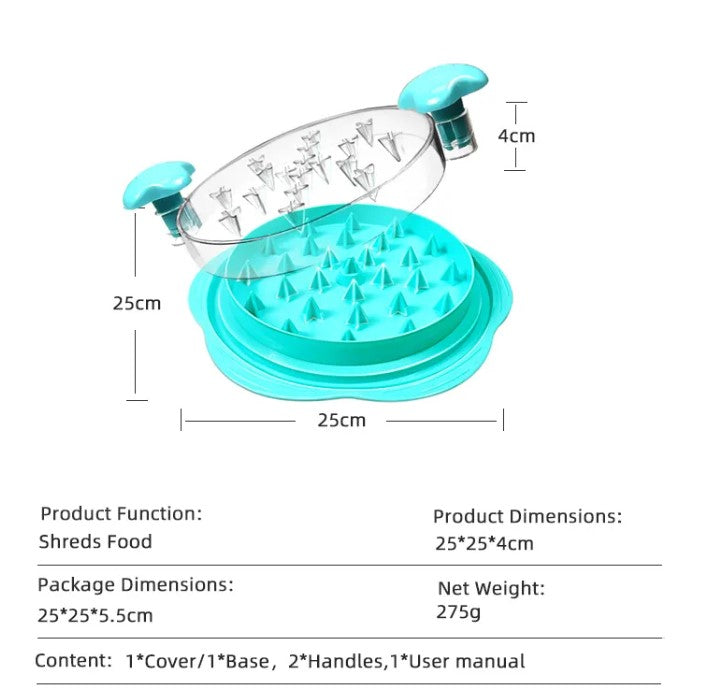
Everything else is a second purchase, made once you know how you actually cook. A useful extra for meal preparation is a twist-to-shred tool: the chicken shredder tool handles cooked chicken, beef or pork with an anti-slip base and a transparent lid. Add a blender or coffee machine only when a real routine demands it.
Durable Cookware for Everyday Cooking: Pans, Pots and What to Skip
Buy three pans, not a fourteen-piece set. Cookware sets pad the box with sizes nobody uses, and the pans you actually reach for are a 24-28cm frying pan, a 1.5-2 litre saucepan, and a 4-5 litre stockpot. A sauté pan is a worthy fourth if you cook for more than two people. Everything else is a second purchase once you know how you actually cook.
Material and construction decide lifespan. Stainless steel with a thick, bonded base resists warping and scratching; a thin base flexes and heats unevenly. Cast iron skillets are near-indestructible and improve with use, though they need drying on the hob and a thin oil layer after washing.
Compatibility matters as much as material. Check induction suitability before you buy if your hob is magnetic-induction; not every stainless steel pan is magnetic, and cast iron almost always is. Check oven-safe limits too: stainless steel and cast iron generally go from hob to oven, while many nonstick pans have handles rated only to around 180-200°C.
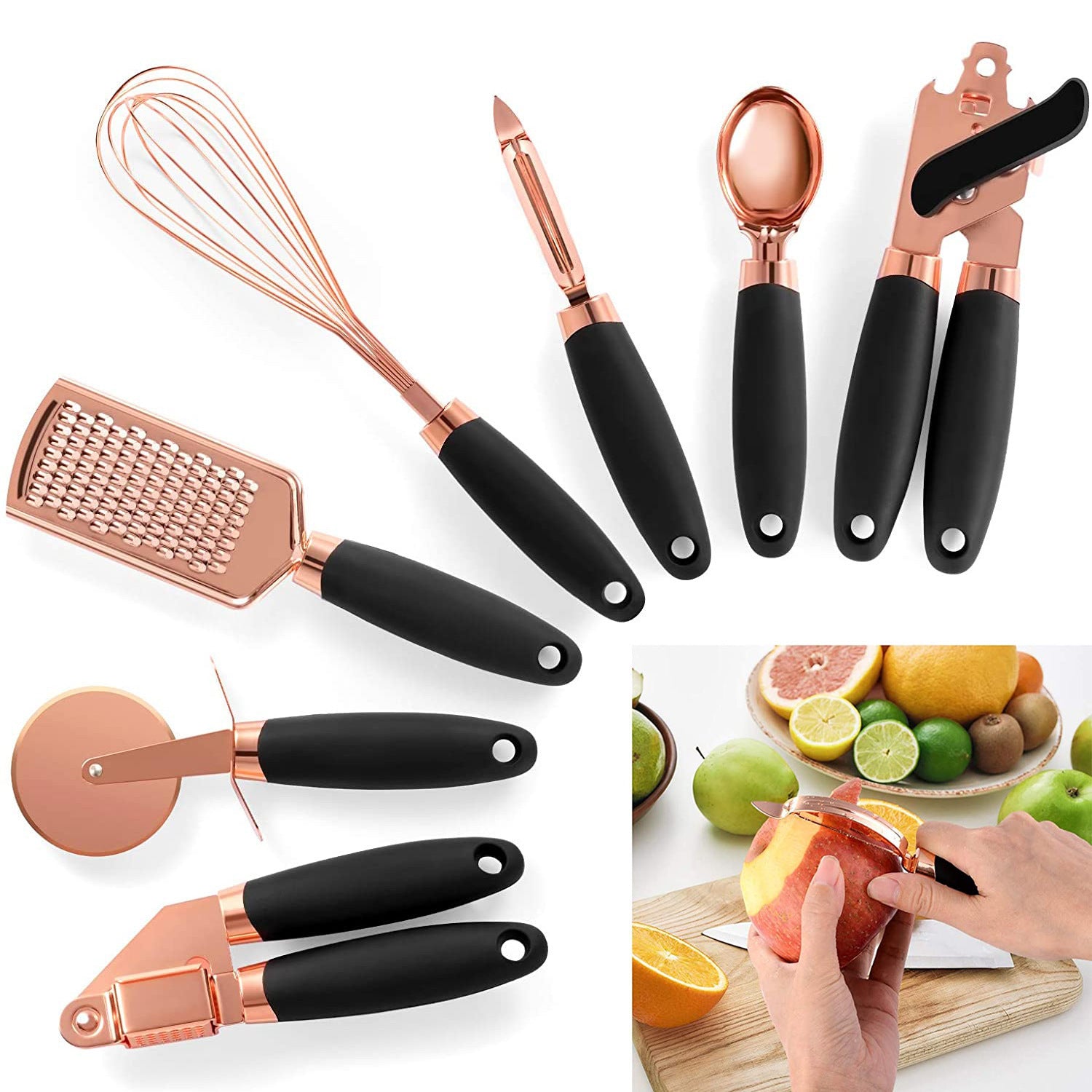
What to skip: novelty pans in odd shapes, enormous sets, and anything so thin it flexes in the hand. A peeler set like our copper-plated kitchen tool set is a better use of money than a fourth pan you will never use.
Expected Lifespan and Cost Per Use
Cost per use is the honest way to judge a kitchen purchase. Cost per use is the honest way to judge a kitchen purchase, since a pan used daily for years spreads its price across many meals. The table below sets out general expectations for each item type.
| Item | Expected Lifespan | Budget Tier | Investment Tier | Cost Per Use Signal |
|---|---|---|---|---|
| Stainless steel pan | 10+ years | Thin base, warps | Thick bonded base, stays flat | Very low over time |
| Cast iron skillet | Decades | Rough finish | Smooth, seasoned | Lowest of all |
| Nonstick frying pan | 2-4 years | Coating flakes early | Better coating, still finite | Recurring cost |
| Chef's knife | 10+ years with sharpening | Soft steel, dulls fast | Hard steel, holds edge | Very low |
| Wooden chopping board | 5-10 years | Thin, cracks | Thick, oiled | Low |
| Silicone utensils | 5+ years | Thin handles | Steel core, food-grade silicone | Low |
The pattern is consistent: spending more upfront on stainless steel, cast iron and good knives lowers the yearly cost, while cheap nonstick quietly becomes the most expensive item in the drawer. A useful rule is to buy the cheapest version of anything you are unsure you will use, and the most durable version of anything you touch daily.
Minimalist Kitchen Essentials: Tools, Knives and Utensils That Earn Their Place
Minimalist kitchen essentials are the tools you reach for daily, and nothing else. A chef's knife, a small paring knife, a bread knife, a wooden chopping board, a separate board for raw meat, a spatula, a slotted spoon, tongs, a ladle, a whisk and a set of measuring spoons cover almost every task.
Knives deserve the largest share of your tool budget. One good chef's knife is generally a better investment than a block of cheaper knives. Keep them sharp with a steel or a home sharpener; a dull knife is more dangerous than a sharp one because it slips.
For utensils, silicone with a stainless steel core is the practical choice: it will not scratch nonstick surfaces and it survives daily heat. The silicone spatula and spoon set and a seven-piece stainless steel gadget set, which includes a bottle opener and can opener, are options for everyday utensils.
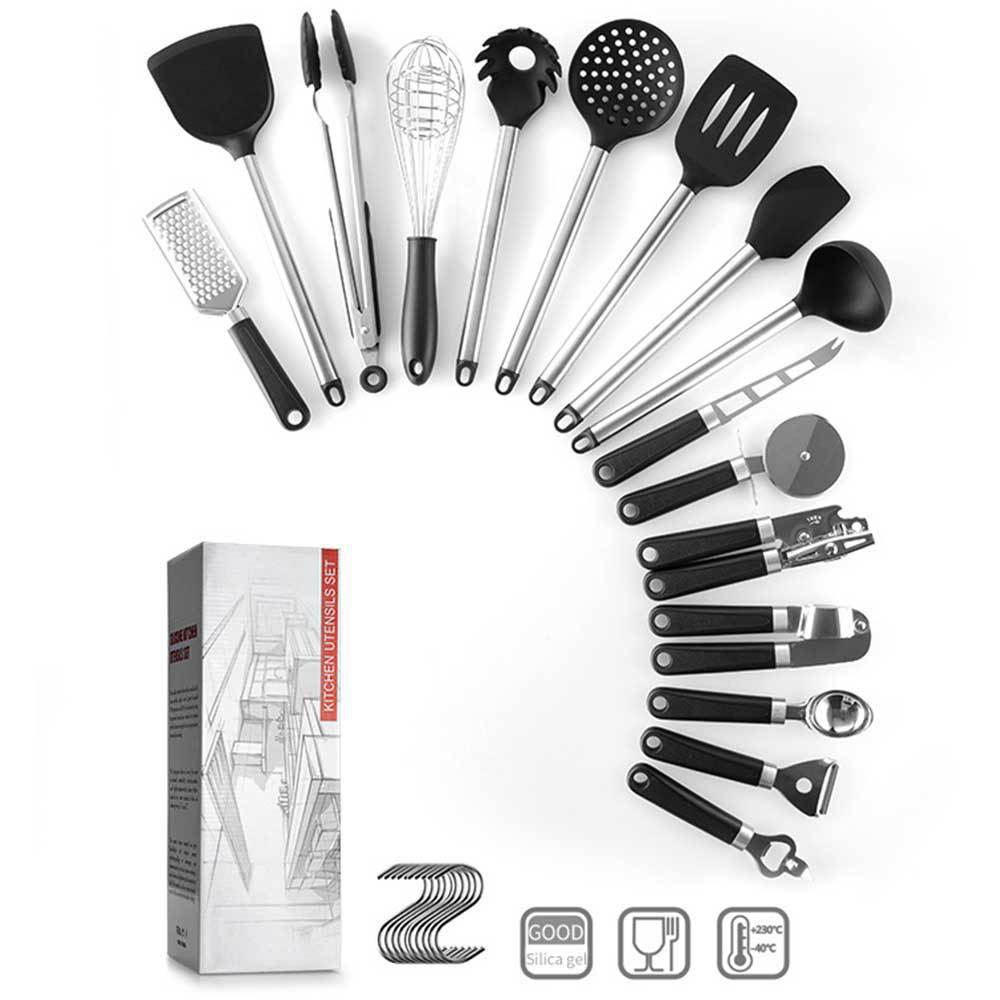
Watch out: buying utensil sets that include six tools you will never use. Count what you actually pick up in a week before adding anything.
Small Kitchen Storage Ideas for a First Apartment
Small kitchen storage works when you store vertically, decant what you use daily, and keep the counter clear. In a first apartment, the counter is your only workspace, so anything sitting on it permanently has to justify itself.
Scale quantities to the household. For one or two people, two saucepans, one frying pan, one stockpot, four to six plates, four bowls, and a cutlery set for four is workable.
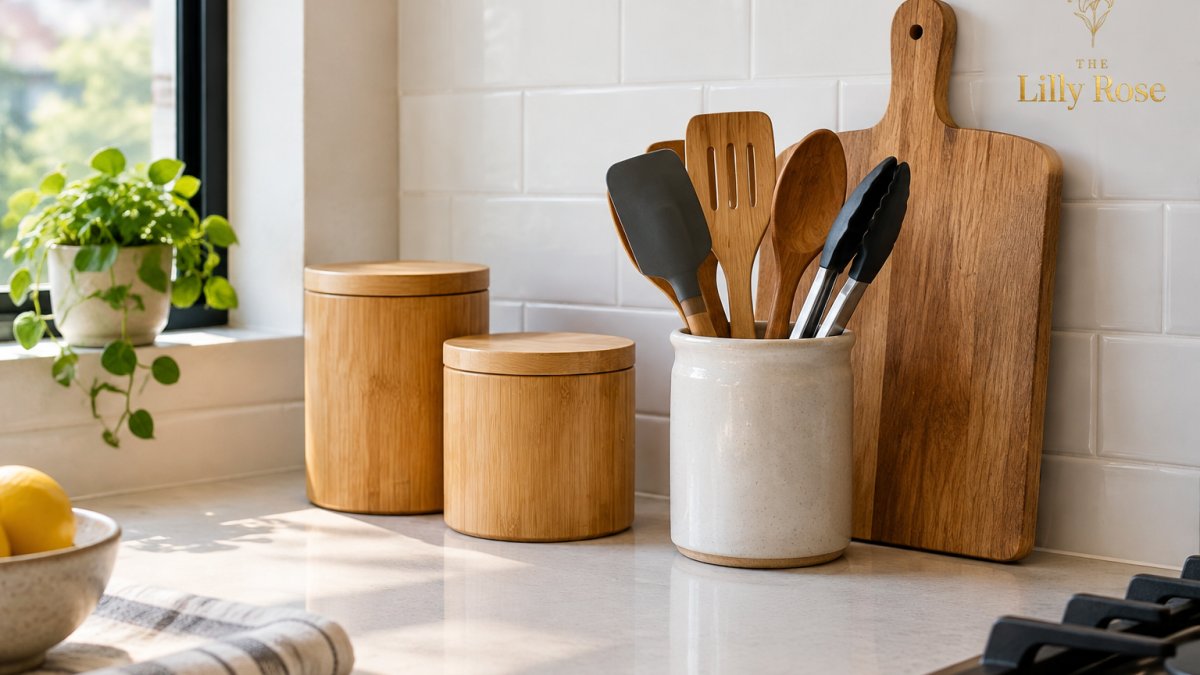
Store vertically and by frequency. Group utensils in one crock rather than scattered across drawers. A bamboo condiment storage jar with its own spoon keeps everyday seasonings within reach and adds a warm natural touch to a modern kitchen.
Watch out: buying storage containers before you know what you store.
The rule we recommend: if it does not fit in a drawer, a cupboard or on a shelf, it does not come into the kitchen.
Care, Maintenance and Material Safety for Kitchen Essentials
Care is what separates a ten-year pan from a two-year one. The routines are simple and take minutes.
- Stainless steel: wash by hand, dry immediately, and avoid harsh abrasives that dull the finish.
- Cast iron: dry on the hob, wipe with a thin layer of oil, and never soak it.
- Nonstick: use silicone or wooden utensils, keep heat moderate, and replace once the coating scratches.
- Knives: hand wash and dry at once, store on a magnetic strip or in a block, and sharpen regularly.
- Wooden boards: oil monthly, never put them in a dishwasher, and retire any board that splits.
- Silicone utensils: dishwasher-safe in most cases, but check the handle core for looseness over time.
On material safety, buy food-grade items and follow the maker's guidance on heat limits. Nonstick coatings should not be overheated or used once damaged. For anything involving food contact materials and their safety requirements, check the Food Safety Authority of Ireland guidance. Disposal of old pans and electrical items is covered by Irish environmental regulations on waste. For general home safety and electrical appliance advice, the Competition and Consumer Protection Commission publishes plain-language guidance.
The common mistake is treating maintenance as optional. A well-cared-for pan costs less per year than three neglected ones.
Shop the Collection for Your First Kitchen
Building a kitchen that lasts is a decision problem, not a shopping spree. Choose fewer items, choose better materials, and let cost per use guide you rather than the sticker price. That approach keeps a first home kitchen functional for years and keeps a small apartment uncluttered.
The Lilly Rose curates kitchen and home pieces with quality, simplicity and functionality in mind, with sustainability as standard. Our collection covers the durable essentials, from stainless steel gadgets and silicone utensils to bamboo storage that earns its counter space. Browse the range and build your first kitchen around items you will still be using a decade from now.
Frequently Asked Questions
What kitchen essentials do you need for your first home?
Start with the items you will use most weeks: one frying pan, one saucepan, a stockpot, a chef's knife, a wooden chopping board, a spatula and spoon, a mixing bowl, a baking tray, plates, bowls and cutlery, plus a kettle and toaster. That covers most everyday cooking. Add a blender, food scales or a coffee maker only when you know you will use them. A short, well-chosen list of kitchen essentials beats a full cupboard of single-use gadgets.
Which kitchen items are worth investing in for durability?
Spend more on the items that take daily wear: cookware, knives and your main utensils. Stainless steel and cast iron generally outlast thin nonstick coatings, and a chef's knife that holds an edge saves replacement costs. A stainless steel utensil set, such as the seven-piece gadgets set at €59.27, is one option for everyday tools. Save on decorative extras and anything you use less than once a month.
How do you set up a minimalist kitchen without feeling short of tools?
Choose tools that do more than one job and store them where you use them. A silicone spatula and spoon set handles cooking and baking, a single good knife replaces a block of cheap ones, and stackable bamboo jars keep counters clear. Keep one spare of the things that break, like spatulas, and nothing else. The test is simple: if an item has not been used in a month, it does not belong on the counter.
How many plates and utensils should you buy for a first home?
For one or two people, four to six of each is enough: dinner plates, side plates, bowls, forks, knives and spoons. That covers daily use plus a small dinner without overfilling small cabinets. Buy a dinner set rather than open stock so the pieces match, and add serving dishes later. If you entertain often, six is the safer number; if space is tight, four plus a couple of spare mugs works well.
How can you choose sustainable kitchen essentials that last?
Prioritise materials that age well and can be maintained rather than replaced: stainless steel, cast iron, bamboo and solid wood. Check that a product lists its material and care instructions, and avoid items with coatings that cannot be repaired. Buying fewer, better-made pieces and looking after them, by seasoning pans and oiling wooden boards, keeps them out of landfill far longer than swapping cheap sets every year.
