

The best digital display wall clock for your home is not necessarily the one with the longest list of features. A display that’s easy to read from your usual seat, suits the room’s lighting and sits naturally with your décor can matter more in everyday life than a host of extras.
Product listings often name functions without showing how useful they’ll be in your space. To compare options, start with where you’ll hang the clock and how you’ll use it. Then assess the display, time format and any extra functions against your daily routine.
This guide covers readability, viewing distance, light, useful functions and visual fit. It also looks at Lilyrose’s 3D LED Wall Clock, Digital Display, a decorative accent with a digital display and 3D LED design. Focus on how you’ll see and use a clock each day, and it becomes easier to choose one that works for both your home and your routine.
Key Takeaways
- Match digit size and contrast to where you’ll read the clock, whether up close or across a shared room.
- Choose a digital display wall clock by weighing its time format and useful functions against your everyday routine.
- Use a simple four-step decision path: settle on the room, viewing point, essential functions and visual feel.
- Consider how the 3D LED Wall Clock, Digital Display could serve as both a time display and a decorative accent.
Digital display wall clock features: what matters in everyday use?
A long feature list can make a clock sound more useful, but each function should have a job in your home. An alarm, temperature reading or extra display option is worth considering if it supports a routine or provides information you regularly need. Otherwise, prioritise a clear display and convenient placement over functions that may go unused.
Feature names alone don’t show how well a particular clock will work in your room. A listing may describe a digital display, for example, but you’ll also want to consider whether its digits will be easy to pick out from your usual seat and in the room’s light. For background on digital clock technology, including common display types, start by deciding what you want the clock to do before comparing options.
Start with the clock’s everyday job
Think about where people in your household will check the time and when. Is it a quick glance while passing through the kitchen, a look from the sofa, or a check before bed? The display should suit that moment. A clock used by several people may need to be visible from more than one position, while one beside a desk may mainly be read from a single seat.
Picture a typical day rather than an ideal one. If people often check the time while moving through a room, give visibility from a distance more weight. If the clock will support a morning routine, consider whether an alarm is important to you. Naming the clock’s main job helps you judge each option by how it will be used, rather than by how many features it lists.
Separate essentials from appealing extras
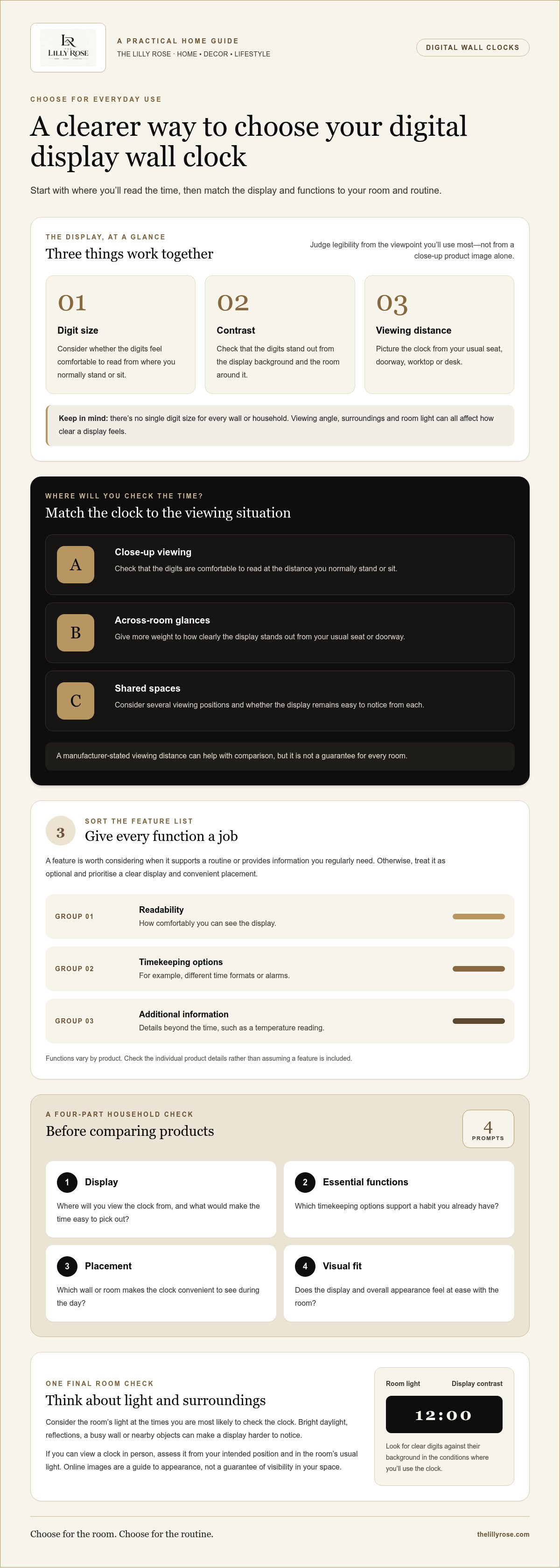
Sort the features you see into three groups: readability, timekeeping options and additional information. Readability is about how comfortably you can see the display. Timekeeping options may include different time formats or alarms, while additional information can include details beyond the time. Functions vary by product, so read the individual product details rather than assuming a feature is included because it’s common in the category.
Before browsing further, make a short household checklist:
- Display: Where will you view the clock from, and what would make the time easy to pick out?
- Essential functions: Which timekeeping options support a habit you already have?
- Placement: Which wall or room makes the clock convenient to see during the day?
- Visual fit: Does its display and overall appearance feel at ease with the room?
Compare each product with your checklist. An extra function is worth considering when you can name a moment you’ll use it. If you can’t, treat it as optional and focus on the basics. This is a practical way to narrow down a digital display wall clock that suits both your routine and your home.
Digital clock display readability: judge size, contrast and viewing distance
A display may look generous in a product photograph but feel different from the chair, doorway or worktop where you’ll read it. Digit size, contrast and viewing distance work together. Larger digits can help at a distance, but they still need to stand out against the display background and surrounding room. There’s no single digit size that suits every wall or household.
Display legibility is how clearly you can read the time from the viewpoint you’ll use most. Use that as your guide, rather than judging from a close-up image alone.
Match the display to the room and viewing position
Picture the clock in place and consider how far away you’ll usually be when you glance at it. A clock near a kitchen worktop may be read from several positions, while one above a desk may mostly be viewed from a single seat. The wall itself matters too: busy patterns, nearby shelves and other objects can compete with the display for attention.
| Viewing situation | What to consider |
|---|---|
| Close-up viewing | Check that the digits look comfortable to read at the distance you’ll normally stand or sit. |
| Across-room glances | Give more weight to how clearly the display stands out from your usual seat or doorway. |
| Shared spaces | Think about several viewing positions and whether the display remains easy to notice from each. |
Manufacturer-stated viewing distances can help you compare products, but they aren’t guarantees for every room. The result depends on the particular display, viewing angle and surroundings. Don’t choose on a distance claim alone, especially if the listing doesn’t show how the digits look at that range.
Think about light and contrast
Contrast affects how readily the digits stand out from their background. A display that looks distinct in a product image may be harder to notice in bright daylight, among reflections or against a visually busy wall. Consider the room’s light at the times you’re most likely to check the clock, not just under one lighting condition.
Brightness controls may appear in product listings, but the name of a control alone doesn’t tell you how the display will look in your home. Compare this feature if it matters to you, and read the product information carefully. If you can view a clock in person, assess it from your intended position and in the room’s usual light. When shopping online, treat product images as a guide to appearance, not a guarantee of visibility in your space.
Readability is both a practical and visual consideration. Once you know where you’ll look from and what the room’s light is like, you can focus on a display that feels clear in daily use. To consider how a clock might sit among your décor, explore Lilyrose’s curated home décor for a thoughtfully chosen accent.
Digital wall clock functions: compare time formats and useful extras
A feature list can make every option sound handy, but a clock is most useful when its functions fit the way your household keeps time. Compare the time format separately from alarms or extra readings, then consider which options would genuinely support your day. Ask yourself: would this function make a regular moment easier, or would it mostly sit unused?
A digital display format describes how the time appears; additional functions are separate options that may serve other purposes. Keeping the two distinct makes it easier to compare products without mistaking a clear time display for a wider set of features.
Choose a time format that feels familiar
A 12-hour format shows hours from 1 to 12, usually with an AM or PM marker to distinguish morning from afternoon. A 24-hour format counts through the day from 00:00 to 23:59. Neither is automatically better for every household. Think about the format you already read comfortably and whether anyone sharing the space prefers another. Check the product details for the format offered rather than assuming it can be changed.
Decide whether extra information earns its place
Alarms, dates and temperature readings are examples of functions found across the digital clock category, not features to expect on every model. An alarm may be useful if you want the clock to support a regular morning routine. A date can provide a quick reference in a shared space, while a temperature reading is useful only if someone at home will refer to it. If another device already does the job, the extra may add little.
| Feature category | Possible everyday purpose | Product-specific detail to verify |
|---|---|---|
| Time format | Showing the time in the style you find easiest to read at a glance. | Whether the clock uses a 12-hour or 24-hour format, and whether it can be changed. |
| Alarm | Supporting a regular wake-up time or another daily reminder. | Whether an alarm is included and how its settings work. |
| Date display | Providing a quick reference to the day or date in a shared room. | Which date information appears and whether it is shown continuously. |
| Temperature reading | Offering a nearby temperature reference if someone in the household uses it. | Whether the reading is included and how the product describes it. |
Use the table as a comparison guide, not a list of must-haves. Functions vary by product, and similar labels don’t always explain how an option is shown or set. Read the details for each clock you’re considering, paying particular attention to whether a function is included and how it works.
Start with the format you’ll recognise quickly, then add only functions linked to a real habit. If your routine doesn’t include setting alarms or checking extra information, a simpler option may feel more natural. Let usefulness, rather than the length of the feature list, guide your decision.
Choose a digital display wall clock for your routine and interior
A clock can be easy to read but feel out of place, or look at home on the wall without serving your daily routine. Thinking about where it belongs helps bring those needs together. Use four practical choices to narrow down your options without redesigning the entire room around one object.
Use the room to narrow your priorities
A shared room often has several viewing points and a steady flow of activity. A kitchen clock, for instance, may be glanced at while people prepare meals or move through the space. In a bedroom or reading corner, it may be checked during quieter moments. Decide where you’ll most often look from before weighing display characteristics or other functions.
- Choose the room. Think about how the clock will be used there. A busy shared space may call for quick, convenient time checks, while a more personal room may have a quieter purpose.
- Set the viewing point. Pick the place you’ll usually read the time from, such as a favourite seat or the spot where you pause during a routine. Keep that viewpoint in mind as you compare displays.
- Choose essential functions. Keep only the options that support habits you actually have. A function that sounds useful in a listing may matter less if another household device already covers it.
- Consider the visual feel. Think about whether the clock’s colour, form and display will sit comfortably with the room’s existing objects and finishes.
Balance a digital display with a calm interior
Digital clarity can sit comfortably in a warm, cottage-inspired home. A clock can be a useful everyday object and a considered decorative accent. Look at the colours and textures around the intended wall, and consider whether the display’s visual presence feels balanced beside nearby décor. Everything needn’t match; a thoughtful contrast can feel just as at ease.
Lilyrose’s 3D LED Wall Clock, Digital Display combines a digital display with a 3D LED design as part of its curated home décor offering. Consider how that visual character fits your room alongside the practical job you want the clock to do. The aim is to choose a piece that feels useful without making the space feel overly functional.
When weighing a decorative LED clock against its surroundings, return to the same four cues: room, viewpoint, routine and visual feel. They offer a simple starting point without turning the choice into a full room redesign.
If you’re ready to explore a clock that can serve as both a time display and a decorative accent, discover Lilyrose’s 3D LED Wall Clock, Digital Display.
Lilyrose’s 3D LED Wall Clock, Digital Display: make a thoughtful choice
After weighing readability, time format and room fit, ask one final question: does the clock suit the way you live as well as the way you want your home to feel? A considered choice doesn’t need the longest list of functions. It should make sense for its place on the wall and feel comfortable among the things you’ve chosen for your home.
Connect the product name with your selection priorities
The 3D LED Wall Clock, Digital Display is part of Lilyrose’s curated home décor collection. Its name describes a 3D LED design and a digital display, giving you a starting point for considering its visual character. Use the product details to assess the practical features that matter to you, rather than assuming additional functions from the name alone.
Think about the intended room and the position from which you’ll read the time. Would the described look feel at ease on that wall? Does a digital display suit the way you prefer to check the time? Consider the clock alongside the room’s colours, textures and surrounding décor. The aim isn’t to make every detail match, but to decide whether the piece feels like a natural part of the space.
Before deciding, ask yourself:
- Will the clock sit in a place where I’m likely to look for the time?
- Does its described visual style feel right for this room?
- Am I choosing it for qualities that matter to my household, rather than features I may not use?
Your answers can help distinguish a passing attraction from a considered choice. If the display and design both appeal, and the clock has a clear place in your routine, it may be worth exploring further.
Explore the Lilyrose clock at your own pace
Lilyrose brings together handpicked décor with a rustic, cottage-inspired sensibility. Within that curated collection, the 3D LED Wall Clock, Digital Display can be considered as both a way to show the time and a decorative accent. Let your everyday needs lead, then decide whether its appearance feels at home with the character you’re creating.
Return to the room, your usual viewing point and the functions you genuinely value. A clock that fits those practical details and sits comfortably with your décor can feel more thoughtfully chosen than one selected for a long feature list alone.
If its 3D LED and digital display design feels right for your home, explore the 3D LED Wall Clock, Digital Display at Lilyrose.
Make room for a clock that feels like yours
Choosing a digital display wall clock is a small decision that can add a useful detail to the rhythm of home. Picture it in place: the everyday glance towards the time, the familiar surroundings and the way its presence feels on the wall. When those details work together, the choice can feel quietly assured.
If the 3D LED Wall Clock, Digital Display has caught your eye, take a closer look at how its design might suit your space. Lilyrose offers free delivery, making it easy to explore this home accent as part of your next décor choice.
Explore Lilyrose’s 3D LED Wall Clock, Digital Display and see whether it feels at home in your plans. Choose a decorative accent that brings everyday usefulness and character to the room.
Frequently Asked Questions
Can a digital display wall clock be mounted on any wall?
No, the right mounting method depends on both the wall surface and the clock’s instructions. Plasterboard, masonry and tiled walls need different fixings, and some surfaces may not suit the supplied mount. Before choosing a spot, check the product guidance and make sure the fixing can support the clock securely. Avoid placing it where a door, cupboard or passing movement could knock it.
Do digital display wall clocks need batteries or mains power?
It depends on the individual clock. Some models run on batteries, while others need a mains connection. Certain designs may use one type of power for the display and another to retain settings. Check the product specifications before deciding where to hang it. For a spot without a nearby socket, consider whether the stated power method suits the room and whether you’re comfortable changing batteries as needed.
How do you set the time on a digital wall clock?
Many clocks are set using controls on the unit or a supplied control device, but the steps vary by model. Follow the instructions for time adjustment, format selection and initial setup. Set the clock somewhere easy to reach, then compare it with a reliable time source before mounting it. If it has separate settings for alarms or other displays, adjust only the options you plan to use.
Is a 12-hour or 24-hour clock display easier to use?
Neither format is universally easier; familiarity is usually the best guide. A 12-hour display may feel natural if you’re used to distinguishing morning from afternoon, while a 24-hour display makes that distinction clear without an AM or PM marker. For a shared household, consider which format everyone reads comfortably. If a clock offers a choice, select the one that makes quick checks feel effortless.
Can a digital wall clock be used in a bedroom?
Yes, a digital wall clock can suit a bedroom if its display and placement feel comfortable there. Consider whether you’ll be able to read it from bed and whether its light might catch your attention when the room is dark. Don’t assume a clock has adjustable brightness or a night setting unless the product details say so. Position it where you can glance at the time without making it a focal point at bedtime.
Are all digital display wall clocks radio controlled?
No. Radio-controlled clocks are designed to receive a time signal, while other digital models require the time to be set manually. Product descriptions should state whether signal reception is included and explain any setup requirements. If you prefer a straightforward clock, manual setting may be all you need. If automatic time adjustment matters to you, look for that specific function rather than assuming every digital display wall clock includes it.
How should you clean a digital display wall clock?
Follow the care instructions for the particular clock. As a gentle general approach, switch it off or disconnect its power if the instructions allow, then wipe the exterior with a soft, dry cloth. Avoid spraying cleaner directly onto the display or letting liquid reach the controls and openings. Don’t use abrasive cloths or harsh products, which may mark the surface. Reconnect or switch it on only when it’s dry.